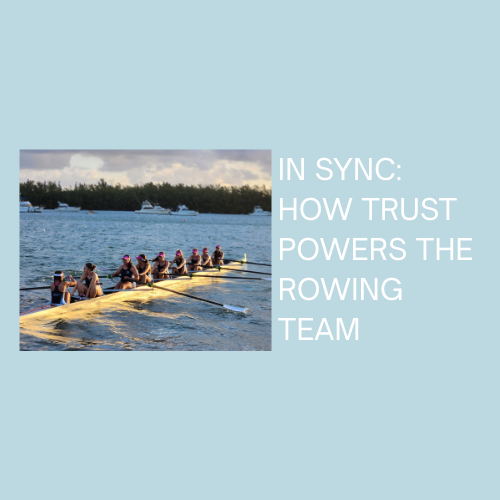
From the outside, rowing looks like a test of strength. But at Lourdes, the sport is defined by something far less outwardly visible: trust. Rowing turns individuals into one unit, guided by discipline, leadership, and the ability to move forward together. While rowing is one of the school’s most overlooked sports, the girls on the team say its impact reaches far beyond the water.
“Everyone has to move in perfect sync,” said junior Eva Diaz, who has been rowing since her sophomore year. “When one person’s off, it ruins the rest of the boat. That’s why chemistry in the boat matters so much.”
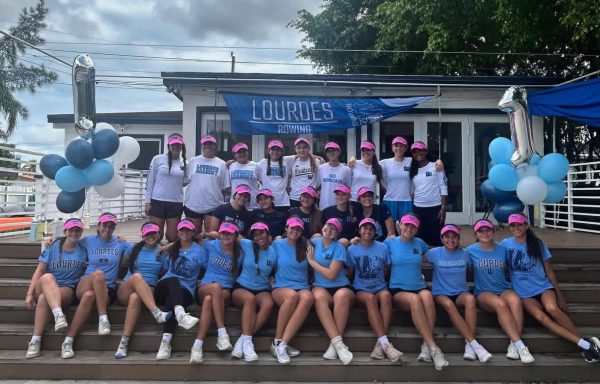
Their chemistry doesn’t happen by accident. The team practices two hours a day, five days a week. They juggle long practices with homework, tests, and early mornings. According to Diaz, that commitment teaches discipline in a way few other sports do. “You get home at 7:30 and still have tests to study for,” she said. “You can’t procrastinate. It forces you to be better overall.”
At the center of that synchronization is the coxswain, who doesn’t even touch an oar. Sophomore Ana Sosa, a coxswain, is responsible for steering, calling technique, watching the course, and motivating the boat all at the same time.
“You have to think about a lot of things at once,” Sosa said. “Steering, making sure you’re not crashing, hitting technical calls, and making sure the rowers aren’t dying out.”
The pressure peaks just before races begin. “My stomach drops. That’s when it hits, that this is actually happening right now,” Sosa said.

Beyond steering, Sosa says being a great coxswain means understanding the people in the boat. Having rowed herself last year, she knows exactly what the athletes are feeling mid-race. “I know what they like to hear,” she said. “I remind them how hard we’ve worked and why we’re here.”
That trust paid off during last year’s Sweep States, when a rower fell off her seat at the start of the race. The boat dropped to last place. “They pulled themselves together,” Sosa said. “We passed every boat and placed second. I was so proud of them.”
Senior captain Abigail Gonzalez has seen firsthand how rowing pushes athletes mentally as much as physically. She says the sport changed her mindset entirely. “Before, I would do things halfway,” Gonzalez said. “Now, I choose the hard route. Rowing taught me it’s okay to be scared. You don’t need to be ready, you just need to do it.” That lesson was tested at the Head of the Charles Regatta, one of the largest rowing competitions in the world, where Gonzalez’s boat flipped in front of thousands of spectators and college recruiters.
“It was my hardest moment,” she said. “But while I was in the water, I just felt grateful to even be there, and I was there with my best friends.” That sense of community is what many rowers say keeps them going, especially during grueling ERG tests, which are long, exhausting workouts on rowing machines. “Nobody leaves practice if you’re the last one. Every single person is there cheering you on,” said Gonzalez.
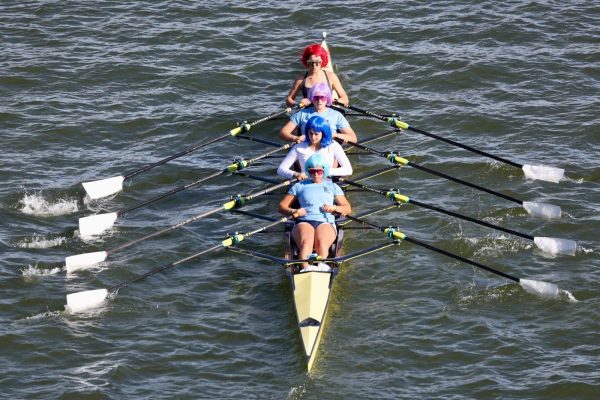
Those moments of shared struggle build confidence. “When people are screaming for you to finish, you push harder than you ever could alone,” Diaz said.
For many of the athletes, rowing has reshaped how they see themselves, not just as competitors, but as people. “It’s made me more of an optimist,” Diaz said. “It’s not just about where you place. It’s about knowing you gave everything you had.”
In a sport where success depends upon unity, the rowing team has learned that strength isn’t just measured in power, but in discipline, leadership, and the ability to move forward together.