Do the Ends Ever Justify the Means?
We’ve all heard the question before: Do the ends justify the means? As students in a Catholic school, we’re taught that our compass isn’t supposed to be convenience or technical correctness; it’s supposed to be values, principles, and truth. And as Americans, our folklore is stitched together with stories of integrity: Washington refusing to lie about a cherry tree, Franklin’s wisdom and diplomacy, and Lincoln’s honesty and resolve. These tales endure because they remind us that we’re meant to live by a higher standard.
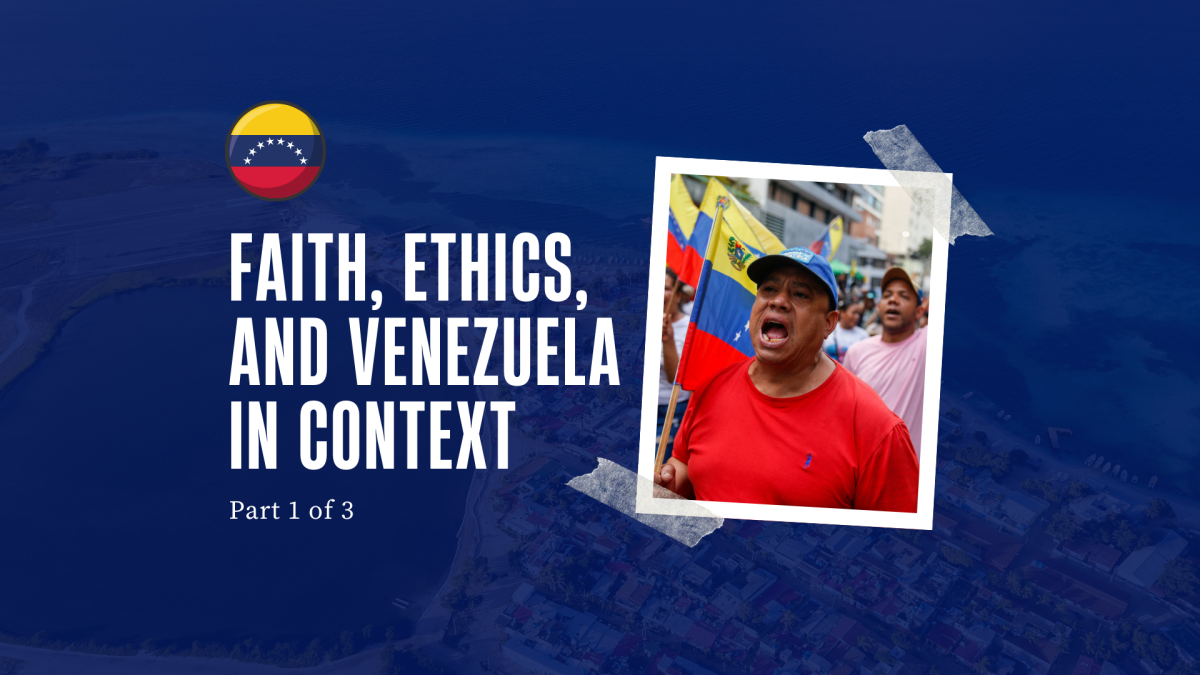
And let’s be honest, no one is lining up to defend Nicolás Maduro. The former Venezuelan leader, captured by U.S. forces just after the new year, left behind a country where one in four citizens fled. Imagine losing a quarter of our Lourdes community. The classrooms would feel emptier, the friendships fractured, the culture diminished. That’s what Venezuela endured: families scattered, voices silenced, and basic needs—food, safety, freedom—vanishing.
Yet here’s the twist: those principles of life, liberty, and the American way, weren’t what triggered U.S. intervention. Within hours, the official rationale shifted from “defending democracy” and “fighting narcotics” to something far less noble … control of Venezuela’s oil reserves.
History’s Echoes
If you’ve taken World or American History, you know this isn’t new. We are a country of contradictions. We love our country, we love the opportunities it offers, and we love the service men and women who serve in our military. Our very own OLLA students graduate and continue their education walking proudly through the halls of the nation’s top military academies. We pray for them and the well-being of all our military. And we are taught to look at life with a critical eye, Latin America has been a stage for American interventions for over a century:
- Cuba (1906-09 and again 1917-22)
- Nicaragua (1912-33)
- Haiti (1915-34)
- And after the CIA was created in 1947, cloak and dagger operations in the Dominican Republic, Ecuador, Brazil, Chile, Guatemala, and El Salvador.
Back then, the catalyst wasn’t always oil, it was bananas, sugar cane, coffee, the Panama Canal, and other resources critical to American business interests. And in nearly every case, the American orchestrated “after” was worse than the “before.” But this isn’t a makeover show where the reveal is brighter teeth, a new wardrobe, and a search online for the latest fit. These are real people: neighbors, grandparents, fellow Catholics. Their lives were upended. In Chile, Allende represented the “before,” and Pinochet—the American‑approved “after”—took his place. His regime was linked to 40,175 victims and a wide range of human‑rights abuses, including torture, executions, detentions, and disappearances.
In Argentina, protestors were thrown alive and conscious from airplanes into the ocean. During this period, the U.S. Ford administration provided these right‑wing military governments throughout South America with counterinsurgency training, financial assistance, and intelligence briefings.
Panama offers another example. Manuel Noriega, later known as a narco terrorist and eventually taken by U.S. special forces to face indictment, had been trained in the United States long before that and received hundreds of thousands of dollars to fight drug trafficking. For six years, the United States supported his rule.
The Gamble of Intervention
So, what’s the plan this time? Overthrowing a regime is the “easy” part. The hard part is planning for the next five years. There is no seamless in-and-out strategy that works. In our digital age where every tragedy is instantly broadcast worldwide, do we really want to gamble with millions of Catholic lives? Already, videos show civilians, not soldiers or alleged drug traffickers at sea, caught in the crossfire of faceless, soulless drones. Their crime … living. If we claim to be a principled democracy, shouldn’t our focus be on creating a sustainable economy for Venezuela’s future, not on how many wardrobe changes or Nike Techs Maduro cycles through in the first 24 hours under custody?
Oil or Principles?
And then there’s the oil question. Do we even need it? The world is sprinting toward renewables while the U.S. clings to coal and gas. According to the World Economic Forum, in 2025, worldwide renewables outpaced coal for the first time. China added more solar and wind capacity in 2025 than the U.S. has in total. Australia announced it would provide three free hours of electricity daily for everyone. Energy is shifting, costs are dropping, and fossil fuels are becoming relics. By stepping into Venezuela for oil, are we too becoming a relic of the past? Even if Venezuela’s reserves are tempting, we’re left with the same haunting question: Do the ends justify the means?
In the next few months, we will measure success by either access to oil or access to food.
The measuring stick we choose will tell us more than any press release ever could. This conversation isn’t over, the next two articles will continue to peel back the layers. Stay tuned.